
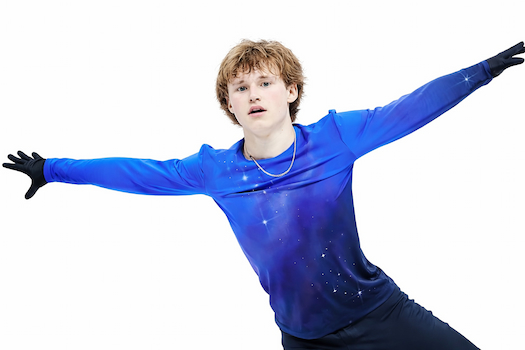
The Quad God’s Blueprint: How Ilia Malinin Rewrote the Physics of Figure Skating
It is February 2026, and the atmosphere inside the Milano Ice Skating Arena is so thick with tension you could carve it with a blade. Ilia Malinin, the 21-year-old American phenomenon known globally as the “Quad God,” stands at center ice.
Just 48 hours earlier, Malinin faced a “breaking point.” In the Olympic team event short program, the “invincible” skater had faltered—a shaky landing on a triple Axel and an under-rotated quad Lutz left him 10 points behind his rival, Yuma Kagiyama. The narrative was shifting: Was the pressure of the Winter Olympics 2026 finally too much for the man who made the impossible look routine?
What happened next became the definitive case study in elite risk management. Malinin didn’t play it safe. He leaned into the chaos. In the free skate, he delivered a history-making performance, landing five quadruple jumps to secure Team USA’s second straight figure skating gold.
This wasn’t just a win; it was a masterclass in professional pivoting. For any entrepreneur, athlete, or creator, Malinin’s journey offers a high-value blueprint on how to scale technical skills while building a brand that survives—and thrives—under the brightest lights on earth.
1. The Innovation Strategy: Engineering the “Impossible”
Most competitors in {industry/niche} focus on incremental gains. Malinin chose radical disruption. He didn’t just want to be the best; he wanted to be the only.
His claim to fame is the quadruple Axel—a jump involving 4.5 rotations that was considered “physically impossible” for decades. By being the first and only person to land a quad Axel in competition, Malinin effectively created a “Blue Ocean” strategy. While others were fighting for fractions of points in artistic execution, Malinin built a technical moat so wide that his margin of victory in some events exceeded 40 points.
The Breakdown of Technical Dominance
-
Precision Mechanics: Malinin treats skating like a physics problem. He famously stated that going from a triple to a quad is simply about “more power or more speed” while keeping the mechanics identical.
-
The “Seven Quad” Program: At the 2025 Grand Prix Final in Nagoya, he became the first skater to land seven quads in a single program, setting a world-record free skate score of 238.24.
-
Diversified Skillsets: He doesn’t just jump. He popularized the “Raspberry Twist” (a horizontal spin leap) and reintroduced the backflip—a move banned for nearly 50 years—to the Olympic stage to boost his “artistic” brand.
Lessons for the Reader:
Identify Your “Quad Axel”: What is the one high-difficulty skill in your field that others are afraid to touch? Master it to eliminate competition.
Data-Driven Iteration: Malinin and his coaches (his parents, Tatiana Malinina and Roman Skorniakov) use repetitive technical drills to make high-risk moves “repeatable results.”
Build a Moat: If you can do what no one else can, you aren’t just a participant; you are the market leader.
2. Branding the “Quad God”: Turning Skill into a Persona
In the Digital Creator Economy, a skill is a commodity; a persona is an asset. Malinin didn’t wait for the media to name him. He branded himself. By adopting the moniker “Quad God” and using the handle @ilia_quadg0d_malinin, he set a psychological standard for himself and his competitors.
This branding served a dual purpose: it created a massive fan following (leading to $700,000 in endorsement earnings in 2025 alone) and acted as a psychological “anchor” during competitions. Even when he felt nervous, he reminded himself: “You are the Quad God; live up to the standard.”
The Commercial Impact
| Metric | Achievement |
| Winning Streak | 14 consecutive international events (2023–2026) |
| Net Worth | Estimated $1 million+ as of early 2026 |
| Sponsorships | Tier-1 partners including Coca-Cola and Xfinity |
| Social Authority | Dominant presence in “skatetok” and viral Olympic clips |
Lessons for the Reader:
Own Your Narrative: Don’t let the industry define you. Create a “hook” or nickname that summarizes your unique value proposition.
The Confidence Anchor: Use your brand persona as a mental tool to stay grounded during high-stakes “performance” moments.
Leverage Scarcity: Malinin limits his media exposure to maintain the “mystique” of his technical feats, driving up his commercial value.
3. The Human Factor: The 2022 Snub and the “Alternate” Pivot
Success is rarely a straight line. Malinin’s “Human Factor” moment came in 2022. Despite placing second at the U.S. Championships at age 17, he was left off the Beijing Olympic team in favor of a veteran. He was named an alternate, forced to watch from the sidelines.
Instead of public venting or losing momentum, Malinin used the “snub” as a fuel source. He transitioned his frustration into a relentless training cycle. Within months of being left behind, he won the 2022 World Junior Championships and began the most dominant run in modern skating history.
Managing the “Artistry vs. Technicality” Crisis
In late 2025, critics argued Malinin was “all jumps and no soul.” He responded by hiring Hall of Fame coach Rafael Arutyunyan and choreographer Shae-Lynn Bourne. He shifted his music from standard classical to Falling in Reverse and Labrinth, using his programs to tell personal stories of suffering and freedom.
Lessons for the Reader:
The “Alternate” Mindset: When you are passed over for a promotion or a project, use that period to “over-skill” so that your next appearance makes you undeniable.
Address Your Weakest Link: Malinin knew his artistry was his “bug.” He didn’t ignore it; he “outsourced” the solution by hiring the best choreographers in the world.
Stay Relatable: Despite his “God” moniker, Malinin frequently reminds fans he is “just a normal teenager” who plays video games and skateboards, keeping his brand human.
4. Family Legacy and the Physics of Success
The question often asked is: “Is Ilia Malinin Russian?” While he is of Russian heritage, he is a proud American born in Virginia. His success is a “family business.” His parents were both Olympic skaters for Uzbekistan, and his grandfather was a Soviet coach.
This “Legacy Blueprint” allowed him to bypass many of the common pitfalls of the sport. He didn’t start competing seriously until age 13—relatively late—which prevented early burnout. His training was individualized, focusing on physics and mechanics rather than just traditional “balletic” movements.
Key Data Points of the Malinin Era
-
First Legal Olympic Backflip: Landed in the 2026 Team Event, ending a 50-year ban.
-
Age at First Quad Axel: 17 years old (September 2022).
-
World Ranking: Consistent #1 throughout the 2024–2026 cycle.
-
Major Titles: 2x World Champion, 3x Grand Prix Final Champion, 4x U.S. Champion.
Lessons for the Reader:
Individualize Your Path: You don’t have to follow the “standard” industry timeline. Starting “late” can sometimes mean you have more “hunger” and fewer injuries.
Consult the Elders: Malinin’s parents provided a “knowledge transfer” that gave him a 10-year head start on technical understanding.
Balance Heritage with Identity: He uses his mother’s last name (Malinin) because it’s easier to pronounce in the U.S. market—a subtle but brilliant branding move.
Summary: The Malinin Strategy vs. Industry Standards
| Feature | Industry Standard | The Malinin “Quad God” Blueprint |
| Risk Profile | Play it safe; minimize mistakes. | High-risk, high-reward; push physical limits. |
| Branding | Professional, stoic, traditional. | Influencer-style branding; “Quad God” persona. |
| Training | Generalist (Artistry + Jumps). | Specialist first (Master the “Impossible” jump). |
| Resilience | Slow recovery from setbacks. | Rapid “pivot” and technical escalation. |
| Fan Engagement | Distant and formal. | Relatable, viral moves (backflips/skateboarding). |
Conclusion: Why the World is Watching
Ilia Malinin’s journey to the 2026 Winter Olympics is more than a sports story; it’s a case study in Technical Excellence meeting Brand Authority. He didn’t just join the figure skating world; he re-engineered its scoring system and forced the International Skating Union to rethink what is “allowed” on the ice.
As we look toward the individual men’s free skate in Milan, the question isn’t whether Malinin will win. The question is: How much further can he push the boundaries of human physics? For the rest of us, the takeaway is clear: find your Quad Axel, name your “God” persona, and never let a setback (like being an “alternate”) define your ceiling.
Sources:
-
International Skating Union (ISU) Official Biographies 2024-2026.
-
The Associated Press: “Malinin’s Stunning Free Skate Secures U.S. Team Gold,” Feb 2026.
-
Time Magazine: “How Skater Ilia Malinin Became the Favorite for Olympic Gold,” Jan 2026.
-
Olympics.com: “Grand Prix Final 2025: Record-breaking performances in Nagoya.”

Leave a Reply