
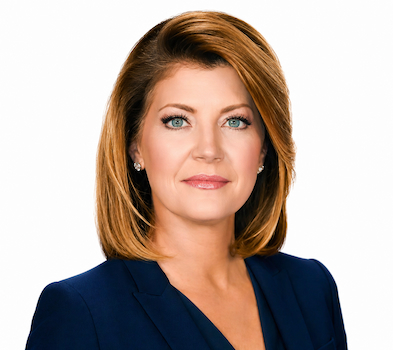
Norah O’Donnell’s Second Act:
How America’s Most Tenacious Anchor Reinvented Her Career — Again
From a $22 million net worth and 30 years of landmark interviews to a fiery on-air confrontation with President Trump, Norah O’Donnell’s journey reveals a masterclass in navigating power, reinvention, and journalistic integrity under pressure.
The Moment That Defined Her Return: The Trump “60 Minutes” Interview
On April 27, 2026 — just one day after a gunman stormed the White House Correspondents’ Association dinner — Norah O’Donnell sat across from President Donald Trump in one of the most combustible television interviews of the year. Within minutes of the broadcast, Trump called her “disgraceful” on air. Twice. She kept going.
That exchange — O’Donnell pressing Trump about the WHCA shooting suspect’s manifesto, Trump erupting and then demanding they continue — became the defining image of her post-anchor chapter. It was not a stumble. It was a demonstration.
This is the “why now.” After voluntarily leaving the CBS Evening News anchor desk on January 23, 2025, many in the industry quietly wondered whether Norah O’Donnell’s best chapters were behind her.
The Trump 60 Minutes interview answered that question definitively: her superpower was never the anchor desk. It was always the room.
Lessons for the reader
- Reinvention is not retreat. Leaving a prestigious title to become a senior correspondent can feel like a step down. O’Donnell’s 60 Minutes Trump interview proves that depth of access can outweigh title prestige.
- Your most visible moment may come after your “peak.” Prepare for it by staying sharp in your craft, not just maintaining your position.
- Controversy handled with composure builds credibility. When Trump called her disgraceful on live television, she did not flinch. Controlled responses to attacks are more memorable than the attacks themselves.
From Army Brat to Anchor of a 1941 Broadcast
The roots that built the journalist
Norah Morahan O’Donnell was born on January 23, 1974 in Washington, D.C. — a date that, by extraordinary coincidence, would also be her final day on the CBS Evening News exactly 51 years later. Her father, Francis Lawrence O’Donnell, was both a medical doctor and a U.S. Army officer.
Three of her four grandparents were immigrants; her roots span Derry, Belfast, and County Donegal on the Irish island, straddling both sides of the border.
This bicultural, military-adjacent upbringing gave O’Donnell something many broadcast journalists lack: an instinctive comfort around institutional power, international complexity, and the human cost of high-stakes decisions.
Growing up with a father who served, and a sister who also served, meant that O’Donnell’s later decision to anchor live from the deck of the U.S.S. Nimitz while it operated in the South China Sea was not bravado — it was personal.
She attended Georgetown University — where she met her future husband, restaurateur Geoff Tracy — and graduated with a degree in Philosophy.
That philosophical training, critics would later note, is visible in her interview style: she does not simply ask questions. She builds argumentative sequences.
The career timeline: three networks, three decades
- 1994Panelist, Youngbloods, National Empowerment Television — her first on-air credit
- 1999Joins NBC News as Washington Bureau correspondent; covers NBC Nightly News, Today Show, Dateline
- 2008Wins Emmy Award for Election Night coverage on NBC News
- 2011Moves to CBS News as Chief White House Correspondent
- 2012Becomes co-anchor of CBS This Morning — remains for seven years
- 2016Diagnosed with melanoma in situ; undergoes surgery; becomes skin cancer awareness advocate
- 2019Appointed anchor and managing editor of CBS Evening News; presses Saudi Crown Prince MBS on Khashoggi assassination
- 2023Anchors live from U.S.S. Nimitz in the South China Sea
- 2024Co-moderates VP debate (Vance vs. Walz); secures global exclusive with Pope Francis; announces Evening News departure
- 2025Final CBS Evening News broadcast, January 23; transitions to 60 Minutes senior correspondent
- 2026Conducts landmark Trump 60 Minutes interview; called “disgraceful” on air — does not stop
Lessons for the reader
- Your background is not a limitation — it is a credential. O’Donnell’s military family, immigrant grandparents, and philosophy degree all compound into an interviewer unlike any other on television.
- Network-switching is a strategic move, not a failure. Moving from NBC to CBS in 2011 unlocked O’Donnell’s most consequential decade.
- Collect milestone events, not just milestone titles. Seven presidential elections. A papal exclusive. An aircraft carrier anchor. These are her real résumé.
The Viral Formula: Why O’Donnell Gets Interviews No One Else Can
Access is earned, not assigned
CBS News CEO Wendy McMahon described O’Donnell’s gift in terms that reveal the mechanism: “Norah’s superpower is her ability to secure and then masterfully deliver unparalleled interviews and stories that set the news cycle and capture the cultural zeitgeist.” The word “secure” is doing heavy lifting in that sentence.
Getting a sitting president, a reigning Pope, or a Saudi Crown Prince to agree to a sit-down interview requires a reputation that precedes every phone call.
O’Donnell built that reputation through three observable strategies that any journalist — or professional in any field — can study and adapt.
Strategy 1 — The fact-check architecture
During her November 2025 60 Minutes interview with Trump (before the even more explosive April 2026 sit-down), O’Donnell deployed what viewers and journalists on social media called a “fact-check cut-away” — pausing the interview to present on-screen corrections to the president’s claims in real time. The response was immediate and polarized, which is exactly what drives viewership.
The technique is not new — it is borrowed from courtroom cross-examination. Present the witness’s statement. Contradict it with documented evidence.
Let the subject respond to the contradiction. O’Donnell has refined this into a broadcast-native format over 30 years.
Strategy 2 — Sustained calm under provocation
When Trump called her “disgraceful” twice during the April 2026 interview, O’Donnell’s response was measured: “The other thing that he wrote, in the —” She continued reading.
She did not raise her voice. She did not offer a defensive aside. Maintaining composure when a subject attempts to destabilize the interview is itself a power move — it signals that the journalist, not the subject, controls the room.
Press freedom groups noted that Trump’s verbal attacks on O’Donnell fit what the Society of Professional Journalists described as “an unmistakable pattern of hostility — often directed at women — that undermines the essential role of a free and independent press.”
Strategy 3 — Range as a brand differentiator
McMahon’s question — “How many people can effortlessly shift from field-anchoring on an aircraft carrier in the Red Sea to sitting down with Bono and Dolly Parton?” — identifies O’Donnell’s most commercially valuable trait: tonal range. Hard geopolitics. Celebrity access. Medical advocacy. Legislative coverage. Each vertical she masters adds a new layer to her interviewing credibility and her advertising value.
Lessons for the reader
- Build a signature technique, then make it unmistakably yours. The fact-check architecture is not original — but O’Donnell’s version of it is recognizable as hers.
- Composure under attack is a skill, not a temperament. It can be practiced. Silence, continuation, and re-direction are learned responses.
- Range protects career longevity. A single-topic expert becomes expendable. A multi-domain authority becomes irreplaceable.
- Secure the room before you enter it. Reputation compounds. Every major interview O’Donnell has done makes the next one easier to schedule.
The Human Factor: A Cancer Diagnosis, a Network Power Play, and the Decision to Walk Away
The melanoma diagnosis that changed her relationship with time
In fall 2016, while co-anchoring CBS This Morning, Norah O’Donnell was diagnosed with melanoma in situ — a form of skin cancer contained to the outer layer of skin but with serious implications if left untreated.
Surgeons removed a three-inch section of skin from her upper left back. The procedure was successful, but the experience was not simply medical — it was existential.
O’Donnell subsequently became a dermatological health advocate, discussing her diagnosis live on air with her dermatologist in 2017, and scheduling skin biopsies every three to four months.
This decision — to make private vulnerability into public advocacy — is a textbook example of how elite professionals convert personal crises into professional authority. She did not just survive a health scare. She turned it into a beat.
The contract renegotiation that went public
Behind the gleaming anchor desk, O’Donnell’s contract negotiations at CBS were complicated. Reports emerged that CBS News used Brian Williams as leverage during O’Donnell’s contract renewal — a classic institutional tactic to suppress talent costs.
For any professional watching from the outside, it was a reminder that even $8 million salaries are subject to the same power dynamics as entry-level negotiations.
Choosing depth over duration
When O’Donnell announced her departure from the CBS Evening News anchor desk in July 2024, she used language that was deliberately milestone-framed rather than defeat-framed: “This presidential election will be my seventh as a journalist, and for many of us in this business we tend to look at our careers in terms of these milestone events.” She had spent 12 years in the anchor chair. She chose to exit on her own terms.
The industry response was mixed. Katie Couric publicly noted that replacing O’Donnell with two men was “out of touch,” adding that seeing women in leadership “inspires our imagination about who can and should fill these roles.”
What O’Donnell’s departure actually demonstrated was something more nuanced: she had read the landscape — the changing economics of broadcast news, the rise of multi-platform journalism — and repositioned herself ahead of the curve, not behind it.
Her final CBS Evening News broadcast on January 23, 2025, saw Oprah Winfrey deliver a surprise tribute via pre-taped message — “Your work as anchor and managing editor has not only won awards, but more importantly, has made such a difference and informed our nation.” It was a send-off that confirmed what the industry already knew: this was not a retirement. It was a pivot.
Lessons for the reader
- Convert personal crisis into professional authority. O’Donnell’s skin cancer diagnosis became a public health platform. Your struggles can become your most credible credential.
- Exit on your own terms — before the institution exits you. Reading industry trajectories and repositioning proactively is more powerful than being pushed.
- Milestone-frame your transitions. How you narrate a career shift shapes how the industry perceives it. “Seven presidential elections as a benchmark” is a more powerful frame than “leaving after five years.”
- Salary negotiations have politics. Understanding that leverage is being used against you is the first step to countering it.
The Full Profile: Personal Life, Vital Stats, and What the Public Doesn’t Always Know
Personal life and family
O’Donnell has been married to Geoff Tracy — owner of the Washington, D.C. restaurant Chef Geoff’s — since June 2001. They met at Georgetown University.
Together they have three children: twins Grace and Henry, born May 20, 2007, and a daughter, Riley Norah Tracy, born July 5, 2008. The name “Riley” was suggested by the late Tim Russert, who died three weeks before the birth.
She splits her time between Washington, D.C. and the Upper West Side of New York City — a practical bifurcation for a journalist whose work routinely bridges the capital and the media industry.
O’Donnell was born under the Aquarius zodiac sign (January 23). She is of Irish descent — both parents trace their roots to Ireland — and holds American nationality. She has been named to Irish American Magazine’s “Top 100 Irish Americans” list and is consistently recognized by Washingtonian Magazine as one of Washington’s 100 most powerful women.
Norah O’Donnell’s Personal Profile
-
Age: 52 (Born 1974)
-
Ethnicity: Caucasian (Irish-American)
-
Nationality: American
-
Relationship Status: Married to Geoff Tracy
-
Zodiac Sign: Aquarius
Height, career longevity, and the numbers behind the name
O’Donnell stands at approximately 5 feet 7 inches — a detail that matters more than it should in an industry still shaped by visual presentation standards.
More meaningfully, her net worth is estimated at $22 million, built across three decades at three major networks, with an annual CBS salary reported at $8 million during her Evening News tenure.
She holds multiple Emmy Awards, a duPont-Columbia Award credit through her 60 Minutes producers, and the distinction of having interviewed every living U.S. president.
Political identity: the question that won’t go away
In an era of partisan media accusations, O’Donnell is routinely asked — or accused, depending on the commenter — whether she is a Democrat or Republican.
The public record shows a journalist who has held elected officials of both parties accountable in documented exchanges, pressed both Democratic and Republican presidents in exclusive interviews, and moderated the 2024 vice presidential debate between JD Vance and Tim Walz alongside Margaret Brennan.
The social media debate, as evidenced by the divided response to her Trump 60 Minutes interviews, says more about the polarized media landscape than it does about O’Donnell’s actual record.
Lessons for the reader
- Protect your long-game relationships. O’Donnell’s marriage to a Georgetown classmate, her children named with input from Tim Russert — her professional life is anchored by deep personal continuity.
- Accept the political perception gap. In polarized environments, neutral journalism will always be accused of bias by both sides. The antidote is not defensiveness — it is a documented record of accountability applied evenly.
- Let the numbers speak. $22M net worth. 30 years. 7 elections. Three children. These data points are not incidental — they are the evidence of a sustainable career architecture.
The Forward-Looking Summary: O’Donnell vs. Industry Standards
What separates Norah O’Donnell’s career trajectory from that of a typical broadcast anchor? The table below compares her approach against common industry patterns.
| Dimension | Norah O’Donnell’s approach | Industry standard | Verdict |
|---|---|---|---|
| Exit strategy | Self-directed departure, milestone-framed, new senior role negotiated in advance | Often reactive; contract non-renewal or forced transition | Ahead of curve |
| Interview access | Every living U.S. president, Pope Francis, Saudi Crown Prince, Dolly Parton, Bono, Oprah | Anchors typically rely on network Rolodex, not personal relationship capital | Elite tier |
| Crisis handling | Cancer diagnosis converted to advocacy platform; on-air attacks met with sustained composure | Personal health often kept private; on-air attacks typically deflected or apologized for | Differentiated |
| Topic range | Geopolitics, celebrity, health, military, political, investigative | Most anchors specialize in 1–2 verticals over time | Ahead of curve |
| Brand neutrality | Consistently accused of bias by both partisan sides — a perverse signal of true balance | Many anchors develop a perceived political lean over time | Resilient |
| Platform evolution | Moved from nightly anchor to 60 Minutes, primetime specials, CBS Mornings, Person to Person | Anchor departures often narrow platform exposure | Expanding |
| Compensation | $8M annual salary; $22M estimated net worth | Top-tier anchors: $3M–$15M annually; median anchor salary: under $1M | Top quartile |
The Takeaway: What the O’Donnell Blueprint Means for You
Norah O’Donnell’s career is not a story about longevity for its own sake. It is a story about the strategic accumulation of trust — with sources, with audiences, with institutions, and with herself.
Every pivot she has made, from NBC to CBS, from co-anchor to evening anchor, from anchor to senior correspondent, has been preceded by an honest assessment of where her real leverage lies.
In a media landscape where nightly news viewership is declining and digital platforms fragment attention, O’Donnell’s transition to 60 Minutes is not a downgrade.
It is a bet on the durability of the long-form, high-access interview — a format she has spent three decades mastering.
Her April 2026 confrontation with Trump on live television, conducted with controlled intelligence against the most hostile possible subject, confirmed that the bet is paying off.
The question worth sitting with — whatever industry you work in — is not “How do I get to the anchor desk?” It is: “What is my actual superpower, and am I building my career around it, or around the title that happens to be available?”
O’Donnell found her answer. She can walk into any room in the world — the Oval Office, the Vatican, an aircraft carrier in the South China Sea — and leave with a story no one else could get.
That is not a job description. That is a career architecture built over thirty years, one interview at a time.
Sources
- Wikipedia — Norah O’Donnell biography (accessed April 2026)
- CBS News — Full transcript, Norah O’Donnell interview with President Trump, April 26, 2026
- Axios — “Trump lashes out at 60 Minutes for asking about gunman manifesto allegations,” April 2026
- Variety — “Norah O’Donnell’s CBS Evening News Exit Set for January,” January 2025
- USA Today / Yahoo News — “Why is Norah O’Donnell leaving CBS Evening News? ‘It’s time,'” January 2025
- Primetimer — “What is Norah O’Donnell’s net worth in 2025?” November 2025
- The List — “What Happened to Norah O’Donnell? All the Details About Her CBS Shake-Up,” August 2024
- TVLine — “CBS Evening News Says Goodbye to Norah O’Donnell With An Assist From Oprah Winfrey,” January 2025

Leave a Reply